> For the complete documentation index, see [llms.txt](https://docs.recognito.vision/llms.txt). Markdown versions of documentation pages are available by appending `.md` to page URLs; this page is available as [Markdown](https://docs.recognito.vision/face-liveness-detection-sdk/integration-guide/android/installation.md).
# Installation
The Android-FaceSDK is provided in **Android Library Project (AAR)** format.
## Download SDK
[**libfacesdk\_core.zip \[33M\]**](https://www.dropbox.com/scl/fi/6udmto3acu8mt7y4x66y9/libfacesdk_core.zip?rlkey=w7gnhvxz8njcvpnssb59a5u60\&st=lckwv8r7\&dl=0)
[**libfacesdk\_pro.zip \[46M\]**](https://www.dropbox.com/scl/fi/m02ykp7ilfevowd7hv6m7/libfacesdk_pro.zip?rlkey=632d06uqpc5s4fhi6cvka9c2a\&st=5lt2kotk\&dl=0)
## Directory Structure
The SDK directory contains the following directories and files:
build.gradle
Gradle build file
facesdk.aar
FaceSDK AAR file
## Add FaceSDK to Android Project
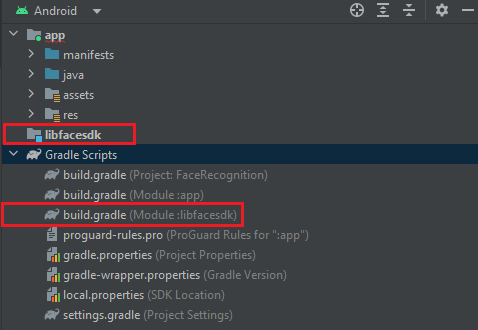
* Add the SDK folder to your Android project's root directory.
* Open the `build.gradle` file corresponding to the new, or existing Android Studio project that you want to integrate. Typically, this is the `build.gradle` file for the `app` module.
* Add the SDK to the `dependencies` section in your `build.gradle` file:
{% code overflow="wrap" %}
```gradle
dependencies {
implementation project(path: ':libfacesdk')
}
```
{% endcode %}
* Include the SDK in your `settings.gradle` file:
{% code overflow="wrap" %}
```gradle
rootProject.name = "YourProjectName"
include ':app'
include ':libfacesdk'
```
{% endcode %}
* Build your project